Week 07 — First Preparation Phase for Stitches
2 November – 8 November 2026
Objective: Begin my pre-production work as Grip on the first production of the semester, Stitches
Dan Thorburn Workshop — Shaping Creative Language
4 November 2026
Speaker background
Background information as supplied for the workshop — not independently verified research.
Today I attended a workshop with Dan Thorburn, an award-winning writer and director from the North of England and a BFI NETWORK alumnus. Originally a painter, he studied at Central Saint Martins before moving into film. His visual arts background gave an interesting context to his discussion of how filmmakers shape meaning.
His drama work has screened internationally, with recognition from BAFTA Connect, Screen Yorkshire’s FLEX programme and the Sony Future Filmmaker Awards. In 2023 he was selected for NETWORK@LFF.
His BFI NETWORK shorts Salt Water Town and Trucker’s Atlas screened at festivals including Raindance, Leeds, LSFF and NFFTY, and his short-film work preceded the UK release of Ken Loach’s Sorry We Missed You.
His debut feature Barfly is in development with the BFI, produced by Chris Hees and Millie Marsh and written by Jack Sherratt. It won Best Project at the Galway Film Market. He is attached to direct In His Place with Mother Films and is developing Wishbone and a regional television adaptation of Salt Water Town.
Dan also created an Arts Council-funded contemporary dance triptych exploring addiction, which screened at Leeds International Film Festival and was praised within the global dance community. These details provide background to the speaker, drawn from the information supplied for the workshop.
Salt Water Town — story and visual language

Dan screened Salt Water Town and discussed creative language within the short-film format. Liam spends his days drinking with friends and racing his motorbike around his Welsh coastal town. He helps his father, Glenn, run a failing caravan park.
Glenn believes prosperity will return, but an insurance inspector reveals that rising sea levels have made their land worthless. Liam tries to convince his father to leave his lifelong home. Their conflict over control of the park leads to desperate measures.
What interested me was how the film’s visual choices communicate their opposing attitudes before dialogue explains everything.
Dan explained that Liam is filmed with shaky handheld camerawork, expressing his rough, restless and youthful energy. Glenn is filmed on sticks, or a tripod, with slow movement or none at all. In this story, that steadiness reflects his character and resistance to change. The contrast gives their relationship a physical expression through the camera.
Costume develops this further. Liam alone wears modern, nylon-style clothing. Glenn’s farmer-style wool jumper and coat connect him with the traditional dress of the town, including Liam’s friends. Liam’s appearance separates him from his surroundings.
Camera movement and costume work together to express the generational conflict efficiently within a short film.
What I learned
I gained a great insight when Dan described creative language as tangible and something that can be moulded. It made filmmaking feel like a set of practical decisions I can shape, test and refine.
Camera support, movement and costume are materials for building meaning, rather than simply choices that make an image look attractive.
The difference between Liam and Glenn helped me understand how these choices communicate character. A still shot can carry as much intention as a moving one. Handheld does not always mean youth, and a static camera does not always mean stubbornness: the meaning comes from the relationship between the technique, character and story.

Applying this to She’s Leaving Home — Camera Operator
I will apply Dan’s idea that creative language can be moulded to my role as camera operator on She’s Leaving Home. I will discuss character perspective and the intended emotional effect with the director and DOP, then use the shot list and blocking to plan framing, headroom, eyelines and movement. In rehearsals, I will explore whether stillness or movement best supports each moment, rather than copying Salt Water Town’s approach without considering our own story.
On set, I will turn these agreed choices into controlled, consistent framing, following the performers and timing camera movements to the action. I will check frame edges for distractions and maintain framing continuity between takes. I will coordinate with the 1st AC on focus marks and changing distances, and with the grip team on safe camera support and movement routes. Reviewing takes with the director and DOP will help me refine the operating. This will connect my practical responsibilities with the storytelling intentions of the film.
Industry Outreach — Contacting Dan Thorburn
4 November 2026
Following the workshop, I contacted Dan Thorburn on Instagram to ask for advice on progressing into professional camera department work. I introduced myself as a third-year Manchester Film School student and outlined my experience as a Camera Operator, 1st AC and 2nd AC on student productions.

I asked how I could get involved in upcoming productions as a Camera Trainee or Camera Assistant, and whether he knew of opportunities to gain experience on professional sets. This was a practical step towards building industry connections and communicating the experience I already have, while being clear about my aim to keep learning.
Reaching out helped me turn my interest in the workshop into an action towards my career development. I kept the message polite and specific, briefly explaining my background before asking for guidance. At the time of this entry, the invitation has been sent and I am awaiting a response; no placement or opportunity has been confirmed.
Instagram message sent to Dan Thorburn, 4 November 2026 — awaiting a response.
Workshop references
Course Brief and ARRI ALEXA Mini Preparation
In the morning, Dan Hutchings revisited the course brief and clarified what I needed to include in the synthesis portfolio. After the break, I read the ARRI ALEXA Mini manual to prepare for the induction, focusing on the menu system and the adjustable MVF-1 monitor.
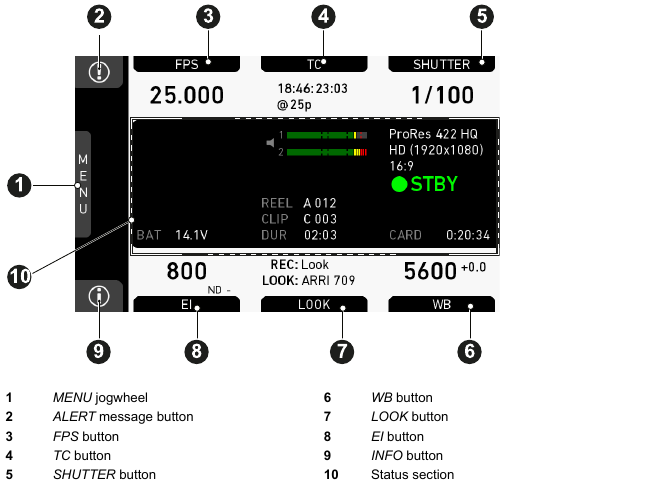
Understanding the home screen and camera menu
The manual helped me distinguish the home screen, which gives quick access to FPS, shutter, EI, white balance and recording status, from the wider camera settings opened with the jogwheel. The oval buttons and jogwheel adjust parameters, while HOME returns to the main screen. This gave me a clearer starting point for the induction and for checking how codec and resolution affect the available maximum FPS.
Understanding the fold-out monitor
The MVF-1 monitor folds out, swivels and folds back with the display facing outwards. Studying the diagram helped me understand how to position it before handling the camera. During the induction, I wanted to practise finding a comfortable viewing angle while keeping the frame and camera information easy to check.
Home-screen controls — ARRI ALEXA Mini User Manual, SUP 5.2, p. 53; camera-menu explanation p. 61.
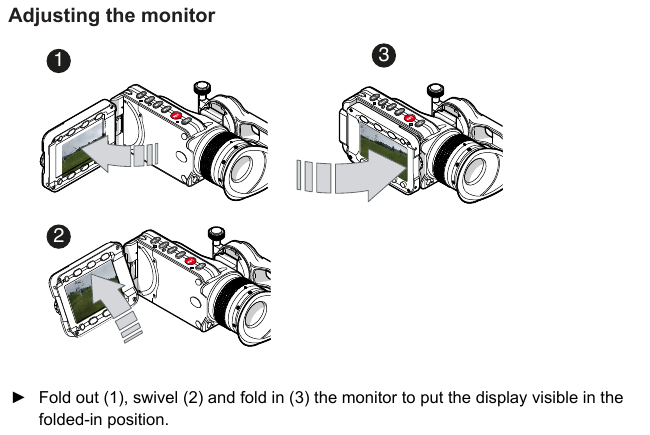
Adjusting the MVF-1 monitor — ARRI ALEXA Mini User Manual, SUP 5.2, section 4.6.3.4, p. 28.
Reference: ARRI ALEXA Mini User Manual, Software Update Packet 5.2, 8 December 2017, pp. 28, 53, 61.
Afternoon — ARRI ALEXA Mini Induction
We rigged the ARRI ALEXA Mini and practised lens changes from both the 1st and 2nd AC’s perspectives, using the claw and spider grips demonstrated during the session. Presenting the lens markings consistently helped the 1st AC anticipate where to place their thumb. In the method we practised, the 1st AC received and fitted the lens with the left hand and used the right hand to secure the mount. Working in both roles showed me how preparation and clear communication make the handover more consistent.


Camera kit packed in its case.

ARRI ALEXA Mini on the workbench.

Lens scale markings and geared rings.

Preparing a lens beside the kit case.
Working together on the camera rig.
Camera rig with handheld support and monitor.
Wireless follow focus
We rigged a Tilta Nucleus Nano wireless follow-focus system for the Easyrig Cinema 3 setup. When calibration stopped working as expected, I investigated the hand controller and noticed it was still in focus-mark setting mode. Resolving this allowed us to continue. I learned to check the selected operating mode before assuming the equipment is faulty, then confirm that focus responds correctly before operating.

Wireless video and Easyrig
Adjusting the camera rig during the induction.


We added the Teradek Bolt 2000 wireless video kit to provide a wireless picture feed alongside remote focus control. Once everything was rigged, I put on the Easyrig Cinema 3 and, with support from my peers, attached the fully set-up ARRI ALEXA Mini. This showed me how camera support, remote focus and wireless monitoring work together. The session developed my confidence in rigging, troubleshooting and communicating with the camera team. My next step is to keep practising both assistant roles so my preparation and handovers become more consistent.
Setting up equipment beside the monitor stand.
Camera image displayed on the external monitor.
Trying on the Easyrig support during the session.
Description
I worked across Dan Thorburn’s creative-language workshop and outreach, then prepared for the ALEXA Mini induction after revisiting the brief and manual. I also rigged the camera, practised both AC roles, diagnosed the Nucleus Nano mode issue, added the Teradek and used the Easyrig with peer support.
Feelings
When we first practised swinging the Zeiss CP.2 lenses, I felt rusty and hesitant. Dan Hutchings reminded us that some production lenses can cost more than a house, which made me more conscious of the responsibility of handling equipment and left me uneasy. This was a general reminder about the value of production equipment, not a claim about the cost of the CP.2 lenses we were using. Repeating the handover from both the 1st and 2nd AC perspectives made me more confident and efficient.
When I discovered that the Nucleus Nano controller was in focus-mark mode, I was taken aback that this simple setting had contributed to a delay of around 10–15 minutes. I recognised that unfamiliarity with the equipment had made the problem harder to identify. Tutor Peter Waiting acknowledged my troubleshooting after I found the cause.
Evaluation
The workshop, manual preparation and induction connected creative decisions with practical camera work. Repeating the lens handover improved my confidence and efficiency as a qualitative self-observation, although I did not record timing or accuracy data. The Nucleus Nano delay showed that a small mode setting and unfamiliar equipment can disrupt workflow; checking the controller mode early would have been useful preparation.
Analysis
Camera support and movement affect storytelling, while secure preparation, communication and troubleshooting help the team work safely and efficiently. The different focus, video and support roles showed how the rig functions as a connected system. Diagnosing the controller mode also showed why learning the controls in advance and checking the selected function before calibration can prevent an incorrect fault assumption. Peter Waiting’s acknowledgement supports this account of my troubleshooting without implying a formal assessment.
Conclusion
I learned that creative thinking and technical preparation support each other, and that both assistant roles depend on clear communication and careful checks. Repeated lens-handover practice can build confidence and efficiency, while unfamiliar controls can make a simple setting harder to diagnose.
Action plan
I will repeat lens changes in both AC roles under supervision, concentrating on secure handling, clear readiness checks and consistent lens orientation. I will learn the Nucleus Nano controls in advance and complete a mode and function check before calibration. I will also practise key ALEXA settings, build a camera-preparation checklist, discuss character perspective with the director and DOP, rehearse framing and movement, and record feedback and evidence in the portfolio.